Esta web utiliza cookies propias y de terceros que nos permiten optimizar tu experiencia en el sitio web, evaluar su rendimiento, generar estadísticas de uso y mejorar y añadir nuevas funcionalidades. Mediante el análisis de tus hábitos de navegación podemos mostrar contenidos más relevantes y medir las interacciones con la web.
Puede obtener más información aquí.
Una cookie es un fichero que se descarga en tu ordenador al acceder a determinadas páginas web.Las cookies permiten a una página web, entre otras cosas, almacenar y recuperar información sobre los hábitos de navegación de un usuario o de su equipo, gestionar el acceso de usuarios a zonas restringidas de la web, etc.Tipo de cookies utiliza esta página web:
Este tipo de cookies permiten al usuario la navegación a través de una página web, plataforma o aplicación y la utilización de las diferentes opciones o servicios que en ella existan como, por ejemplo, controlar el tráfico y la comunicación de datos, identificar la sesión, acceder a partes de acceso restringido, seleccionar el idioma, o compartir contenidos a través de redes sociales.
| Nombre | Descripcion | Duración | Habilitado |
|---|---|---|---|
| ID de tu sesión. Te identifica en este navegador y nos permite gestionar tus cookies o almacenar tu cesta de la compra. | 8760 horas | ||
| Indica qué cookies has aceptado. | 8760 horas | ||
| Una cookie PHPSESSID es una cookie de sesión que se utiliza para identificar la sesión de un usuario en un sitio web. | 8760 horas |
Son aquéllas que posibilitan el seguimiento y análisis del comportamiento de los usuarios en nuestra página. La información recogida se utiliza para la medición de la actividad de los usuarios en la web y la elaboración de perfiles de navegación de los usuarios, con la finalidad de mejorar la web, así como los productos y servicios ofertados.
| Nombre | Descripcion | Duración | Habilitado |
|---|---|---|---|
| Es un servicio de analítica web que utiliza cookies de análisis. | 8760 horas |
Estas cookies pueden ser establecidas a través de nuestro sitio por nuestros socios publicitarios. Pueden ser utilizadas por esas empresas para crear un perfil de sus intereses y mostrarle anuncios relevantes en otros sitios. No almacenan directamente información personal, sino que se basan en la identificación única de su navegador y dispositivo de Internet. Si no permite utilizar estas cookies, verá menos publicidad dirigida.
| Nombre | Descripcion | Duración | Habilitado |
|---|
O que são os cookies?
Um cookie é um arquivo descarregado no seu computador para aceder certos sites. Os cookies permitem que um site, entre outras coisas, possa armazenar e recuperar informações sobre os hábitos de navegação de um/a usuário/a ou do seu computador, gerenciar o acesso do/a usuário/a às áreas restritas do site etc.
Que tipo de cookies utiliza este site?
Cookies de análise
São aqueles que permitem a monitorização e análise do comportamento do/a usuário/a no nosso site. A informação recolhida é usada para medir a atividade dos/as usuários/as no site e para criar perfis de navegação do/a usuário/a, a fim de melhorar o site e os produtos e serviços oferecidos.
Cookies técnicos
Permitem ao/à usuário/a navegar através dum site, plataforma ou aplicação e o uso de diferentes opções ou serviços que existem, como por exemplo o controlo do tráfego e comunicação de dados, identificar a sessão, aceder a áreas de acesso restrito, ou compartilhar conteúdos através de redes sociais.
Cookies de personalização
São aqueles que permitem adaptar a navegação no site com as suas preferências, como o idioma, navegador utilizado etc.
| Nome | Própria / Terceiros | Duração | Descrição | Proprietário |
| gat | Terceiros | 1 minuto | É usado para limitar a porcentagem de solicitações. | Google Analytics |
| _ga | Terceiros | 2 anos | É usado para distinguir os usuários. | Google Analytics |
| _gid | Terceiros | 24 horas | É usado para distinguir os usuários. | Google Analytics |
| PHPSESSID | Própria | Sesion | Cookie de sessão, desaparece quando a web é fechada. | Arnoia |
| COOKIE_CONSENT | Própria | 1 mês | Cookie de personalização. | Arnoia |
| SESS_ID | Própria | 10 dias | Cookie de sessão. | Arnoia |
Quem usa os cookies?
Os cookies utilizados neste site são usados pelo responsável legal do mesmo e pelos seguintes serviços ou fornecedores de serviços:
- Google Analytics: é um serviço de análise da web que usa cookies de análise. Voçê pode verificar a política de privacidade deste serviço no site https://www.google.com/intl/pt-PT/policies/
Como posso desativar ou excluir os cookies?
Voçê pode permitir, bloquear ou apagar os cookies instalados no seu computador configurando as opções do navegador instalado. As seguintes ligações fornecem informações adicionais sobre as opções de configuração dos cookies nos distintos navegadores:
– Internet Explorer: https://support.microsoft.com/pt-pt/help/278835/how-to-delete-cookie-files-in-internet-explorer
– Google Chrome: https://support.google.com/chrome/answer/95647?hl=pt
– Firefox: https://support.mozilla.org/t5/Cookies-and-cache/Ativar-e-desativar-cookies-que-os-websites-utilizam-para/ta-p/14289
– Safari: https://support.apple.com/kb/PH21411?locale=pt_PT

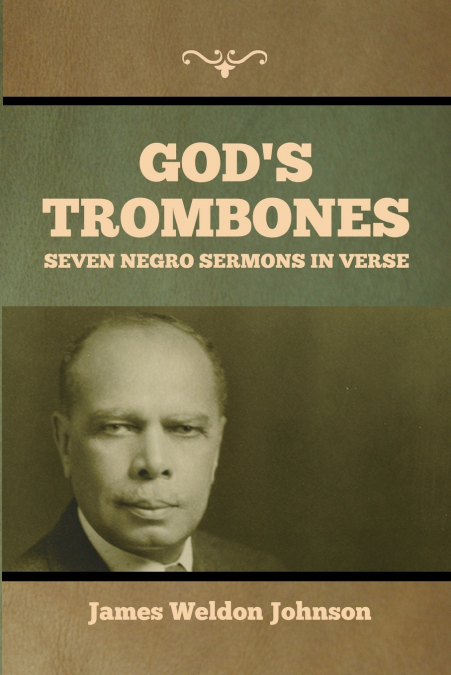
God?s Trombones: Seven Negro Sermons in Verse is a 1927 book of poems by James Weldon Johnson patterned after traditional African-American religious oratory. African-American scholars Henry Louis Gates and Cornel West have identified the collection as one of Johnson?s two most notable works, the other being Autobiography of an Ex-Colored Man. Johnson observed an absence of attention in folklore studies to what he called a 'folk sermon,' then went on to describe its nature and specific examples from his memory:I remember hearing in my boyhood sermons that were current, sermons that passed with only slight modifications from preacher to preacher and from locality to locality. Such sermons were: 'The Valley of Dry Bones,' which was based on the vision of the prophet in the 37th chapter of Ezekiel, the 'Train Sermon,' in which both God and the devil were pictured as running trains, one loaded with saints, that pulled up in heaven, and the other with sinners, that dumped its load in hell, the 'Heavenly March,' which gave in detail the journey of the faithful from earth, on up through the pearly gates to the great white throne. Then there was a stereotyped sermon which had no definite subject, and which was quite generally preached, it began with the Creation, went on to the fall of man, rambled through the trials and tribulations of the Hebrew Children, came down to the redemption by Christ, and ended with the Judgment Day and a warning and an exhortation to sinners.Johnson explains the title?s use of the trombone by discussing the vocal and rhetorical qualities of a preacher he had recently heard who, he felt, exemplified the compelling and persuasive nature of the folk preacher, naming the trombone as 'the instrument possessing above all others the power to express the wide and varied range of emotions encompassed by the human voice - and with greater amplitude.' He also cited a dictionary definition that noted the trombone as being the brass instrument most resembling the range and sound of the human voice.The seven poems were composed primarily in 1926, with 'Go Down[,] Death' being composed in the space of a single afternoon on Thanksgiving Day, 1926, and the remaining five poems during a two-week retreat, 'The Creation,' the first poem of the set, had been composed about 1919.The work went on to find acclaim in many circles, proving 'enormously popular among both the black cognoscenti as well of the masses of black Americans' and being used widely in oratorical contests, poet Owen Dodson wrote Johnson in 1932 to tell him that Dodson and his brother had taken first and second place in a poetry-recitation competition with works from that volume.Gates and West particularly note that the work 'attempts a mimetic capturing of the black church sermon... without making recourse to the misspellings and orthographic tricks often employed in representing black vernacular speech.' Dorothy Canfield Fisher, in a personal letter to the poet to thank him and offer to help promote the collection, praised the work as 'heart-shakingly beautiful and original, with the peculiar piercing tenderness and intimacy which seems to me special gifts of the Negro. ...it is a profound satisfaction to find those special qualities so exquisitely expressed.'The poem 'The Creation' was used in the 1951 film Five, serving as the soliloquy for the character Charles, played by African-American actor Charles Lampkin. Lampkin convinced film-maker Arch Oboler to include excerpts of the poem in the final script of Five where it would become Lampkin?s soliloquy for his character Charles. This may be the first time that audiences in the USA, Latin America, and Europe were exposed to African-American poetry, albeit not identified as such in the film. (wikipedia.org)