Esta web utiliza cookies propias y de terceros que nos permiten optimizar tu experiencia en el sitio web, evaluar su rendimiento, generar estadísticas de uso y mejorar y añadir nuevas funcionalidades. Mediante el análisis de tus hábitos de navegación podemos mostrar contenidos más relevantes y medir las interacciones con la web.
Puede obtener más información aquí.
Una cookie es un fichero que se descarga en tu ordenador al acceder a determinadas páginas web.Las cookies permiten a una página web, entre otras cosas, almacenar y recuperar información sobre los hábitos de navegación de un usuario o de su equipo, gestionar el acceso de usuarios a zonas restringidas de la web, etc.Tipo de cookies utiliza esta página web:
Este tipo de cookies permiten al usuario la navegación a través de una página web, plataforma o aplicación y la utilización de las diferentes opciones o servicios que en ella existan como, por ejemplo, controlar el tráfico y la comunicación de datos, identificar la sesión, acceder a partes de acceso restringido, seleccionar el idioma, o compartir contenidos a través de redes sociales.
| Nombre | Descripcion | Duración | Habilitado |
|---|---|---|---|
| ID de tu sesión. Te identifica en este navegador y nos permite gestionar tus cookies o almacenar tu cesta de la compra. | 8760 horas | ||
| Indica qué cookies has aceptado. | 8760 horas | ||
| Una cookie PHPSESSID es una cookie de sesión que se utiliza para identificar la sesión de un usuario en un sitio web. | 8760 horas |
Son aquéllas que posibilitan el seguimiento y análisis del comportamiento de los usuarios en nuestra página. La información recogida se utiliza para la medición de la actividad de los usuarios en la web y la elaboración de perfiles de navegación de los usuarios, con la finalidad de mejorar la web, así como los productos y servicios ofertados.
| Nombre | Descripcion | Duración | Habilitado |
|---|---|---|---|
| Es un servicio de analítica web que utiliza cookies de análisis. | 8760 horas |
Estas cookies pueden ser establecidas a través de nuestro sitio por nuestros socios publicitarios. Pueden ser utilizadas por esas empresas para crear un perfil de sus intereses y mostrarle anuncios relevantes en otros sitios. No almacenan directamente información personal, sino que se basan en la identificación única de su navegador y dispositivo de Internet. Si no permite utilizar estas cookies, verá menos publicidad dirigida.
| Nombre | Descripcion | Duración | Habilitado |
|---|
O que são os cookies?
Um cookie é um arquivo descarregado no seu computador para aceder certos sites. Os cookies permitem que um site, entre outras coisas, possa armazenar e recuperar informações sobre os hábitos de navegação de um/a usuário/a ou do seu computador, gerenciar o acesso do/a usuário/a às áreas restritas do site etc.
Que tipo de cookies utiliza este site?
Cookies de análise
São aqueles que permitem a monitorização e análise do comportamento do/a usuário/a no nosso site. A informação recolhida é usada para medir a atividade dos/as usuários/as no site e para criar perfis de navegação do/a usuário/a, a fim de melhorar o site e os produtos e serviços oferecidos.
Cookies técnicos
Permitem ao/à usuário/a navegar através dum site, plataforma ou aplicação e o uso de diferentes opções ou serviços que existem, como por exemplo o controlo do tráfego e comunicação de dados, identificar a sessão, aceder a áreas de acesso restrito, ou compartilhar conteúdos através de redes sociais.
Cookies de personalização
São aqueles que permitem adaptar a navegação no site com as suas preferências, como o idioma, navegador utilizado etc.
| Nome | Própria / Terceiros | Duração | Descrição | Proprietário |
| gat | Terceiros | 1 minuto | É usado para limitar a porcentagem de solicitações. | Google Analytics |
| _ga | Terceiros | 2 anos | É usado para distinguir os usuários. | Google Analytics |
| _gid | Terceiros | 24 horas | É usado para distinguir os usuários. | Google Analytics |
| PHPSESSID | Própria | Sesion | Cookie de sessão, desaparece quando a web é fechada. | Arnoia |
| COOKIE_CONSENT | Própria | 1 mês | Cookie de personalização. | Arnoia |
| SESS_ID | Própria | 10 dias | Cookie de sessão. | Arnoia |
Quem usa os cookies?
Os cookies utilizados neste site são usados pelo responsável legal do mesmo e pelos seguintes serviços ou fornecedores de serviços:
- Google Analytics: é um serviço de análise da web que usa cookies de análise. Voçê pode verificar a política de privacidade deste serviço no site https://www.google.com/intl/pt-PT/policies/
Como posso desativar ou excluir os cookies?
Voçê pode permitir, bloquear ou apagar os cookies instalados no seu computador configurando as opções do navegador instalado. As seguintes ligações fornecem informações adicionais sobre as opções de configuração dos cookies nos distintos navegadores:
– Internet Explorer: https://support.microsoft.com/pt-pt/help/278835/how-to-delete-cookie-files-in-internet-explorer
– Google Chrome: https://support.google.com/chrome/answer/95647?hl=pt
– Firefox: https://support.mozilla.org/t5/Cookies-and-cache/Ativar-e-desativar-cookies-que-os-websites-utilizam-para/ta-p/14289
– Safari: https://support.apple.com/kb/PH21411?locale=pt_PT
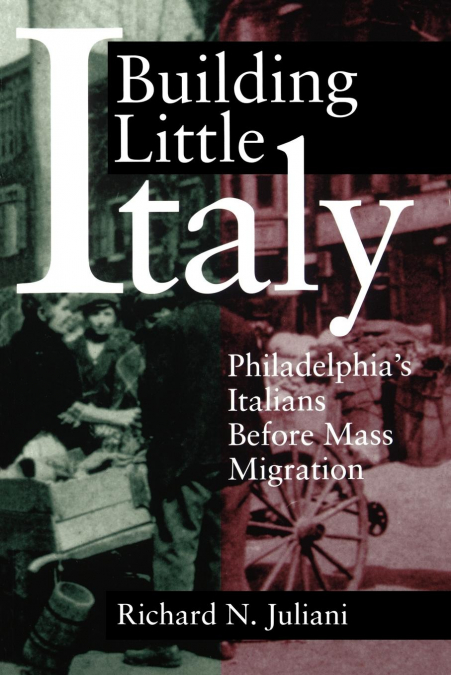
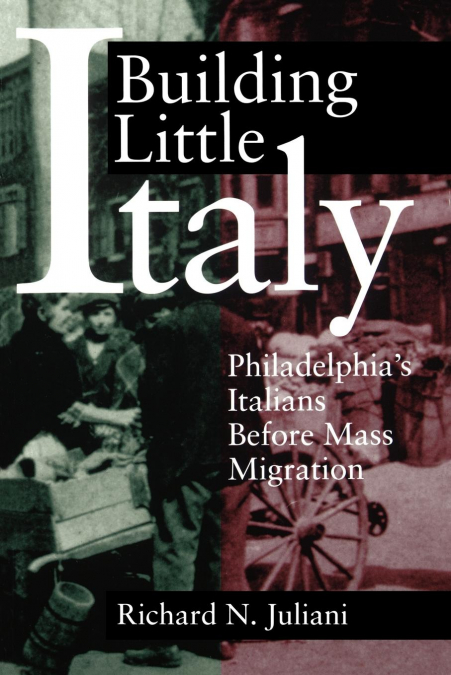
'In Building Little Italy, Richard Juliani has given us the definitive case study of Italian community formation in the United States. No other scholar has so exhaustively researched, so skillfully written about, or so imaginatively conceived the question of early Italian settlement before the age of mass migration. It will remain the essential guide for all future work in the field.' -Philip V. Cannistraro, Queens College/CUNY 'Building Little Italy is an insightful and compelling account of the creation and dynamic development of Philadelphia's Italian community. Richard Juliani has provided a model of how ethnic history should be written.' -Spencer Di Scala, University of Massachusetts at Boston Richard N. Juliani is Professor of Sociology at Villanova University. He is the author of The Social Organization of Immigration: The Italians in Philadelphia (Arno Press/New York Times, 1980) and co-editor of New Explorations in Italian American Studies (American Italian Historical Association, 1994). 'Building Little Italy is clearly the culmination of countless hours, indeed years, of spadework into nineteenth-century sources required to construct such a through profile of community life.' -Peter R. D'Agostino, The Italian American Review '...Juliani has produced a work of remarkable scholarship. Building Little Italy, not only fills a gap in the growing literature on the Italian-Aerican experience but will also serve as the standard reference for further research in the field.' -Stefano Luconi, American Studies 'Building Little Italy is a serious work of scholarship that sheds consideranble light on areas of history and population study where previously there were but shadows.' -Albert DiBartolomeo, The Philadelphia Inquirer Philadelphia's first Italian immigrants arrived in the mid-eighteenth century. Artists and scholars, tradesmen and entrepreneurs, they established a new community-one of the first 'Little Italies' in America-that would provide not just a home but a sense of belonging for later arrivals. Richard Juliani tells the story of early Italians in the City of Brotherly Love: why they chose that city, what their lives were like, where they lived, and how they interacted. Examining Italian settlement from pre-Revolutionary times up to the eve of mass migration in the 1870s, he shows how these early pioneers created the basic structure of the community that would continue into the twentieth century. Juliani has devoted thirty years of research-combing through newspapers, public archives, religious records, business documents, and files of private organizations-to recapturing the creation of a community. He describes such factors as regional origins, methods of migration, and population growth, patterns of age, sex, income, and occupation, family structure and living arrangements, and the formation of communal institutions. But more than providing data, Juliani explores the private lives of many individuals in the Italian