Esta web utiliza cookies propias y de terceros que nos permiten optimizar tu experiencia en el sitio web, evaluar su rendimiento, generar estadísticas de uso y mejorar y añadir nuevas funcionalidades. Mediante el análisis de tus hábitos de navegación podemos mostrar contenidos más relevantes y medir las interacciones con la web.
Puede obtener más información aquí.
Una cookie es un fichero que se descarga en tu ordenador al acceder a determinadas páginas web.Las cookies permiten a una página web, entre otras cosas, almacenar y recuperar información sobre los hábitos de navegación de un usuario o de su equipo, gestionar el acceso de usuarios a zonas restringidas de la web, etc.Tipo de cookies utiliza esta página web:
Este tipo de cookies permiten al usuario la navegación a través de una página web, plataforma o aplicación y la utilización de las diferentes opciones o servicios que en ella existan como, por ejemplo, controlar el tráfico y la comunicación de datos, identificar la sesión, acceder a partes de acceso restringido, seleccionar el idioma, o compartir contenidos a través de redes sociales.
| Nombre | Descripcion | Duración | Habilitado |
|---|---|---|---|
| ID de tu sesión. Te identifica en este navegador y nos permite gestionar tus cookies o almacenar tu cesta de la compra. | 8760 horas | ||
| Indica qué cookies has aceptado. | 8760 horas | ||
| Una cookie PHPSESSID es una cookie de sesión que se utiliza para identificar la sesión de un usuario en un sitio web. | 8760 horas |
Son aquéllas que posibilitan el seguimiento y análisis del comportamiento de los usuarios en nuestra página. La información recogida se utiliza para la medición de la actividad de los usuarios en la web y la elaboración de perfiles de navegación de los usuarios, con la finalidad de mejorar la web, así como los productos y servicios ofertados.
| Nombre | Descripcion | Duración | Habilitado |
|---|---|---|---|
| Es un servicio de analítica web que utiliza cookies de análisis. | 8760 horas |
Estas cookies pueden ser establecidas a través de nuestro sitio por nuestros socios publicitarios. Pueden ser utilizadas por esas empresas para crear un perfil de sus intereses y mostrarle anuncios relevantes en otros sitios. No almacenan directamente información personal, sino que se basan en la identificación única de su navegador y dispositivo de Internet. Si no permite utilizar estas cookies, verá menos publicidad dirigida.
| Nombre | Descripcion | Duración | Habilitado |
|---|
O que são os cookies?
Um cookie é um arquivo descarregado no seu computador para aceder certos sites. Os cookies permitem que um site, entre outras coisas, possa armazenar e recuperar informações sobre os hábitos de navegação de um/a usuário/a ou do seu computador, gerenciar o acesso do/a usuário/a às áreas restritas do site etc.
Que tipo de cookies utiliza este site?
Cookies de análise
São aqueles que permitem a monitorização e análise do comportamento do/a usuário/a no nosso site. A informação recolhida é usada para medir a atividade dos/as usuários/as no site e para criar perfis de navegação do/a usuário/a, a fim de melhorar o site e os produtos e serviços oferecidos.
Cookies técnicos
Permitem ao/à usuário/a navegar através dum site, plataforma ou aplicação e o uso de diferentes opções ou serviços que existem, como por exemplo o controlo do tráfego e comunicação de dados, identificar a sessão, aceder a áreas de acesso restrito, ou compartilhar conteúdos através de redes sociais.
Cookies de personalização
São aqueles que permitem adaptar a navegação no site com as suas preferências, como o idioma, navegador utilizado etc.
| Nome | Própria / Terceiros | Duração | Descrição | Proprietário |
| gat | Terceiros | 1 minuto | É usado para limitar a porcentagem de solicitações. | Google Analytics |
| _ga | Terceiros | 2 anos | É usado para distinguir os usuários. | Google Analytics |
| _gid | Terceiros | 24 horas | É usado para distinguir os usuários. | Google Analytics |
| PHPSESSID | Própria | Sesion | Cookie de sessão, desaparece quando a web é fechada. | Arnoia |
| COOKIE_CONSENT | Própria | 1 mês | Cookie de personalização. | Arnoia |
| SESS_ID | Própria | 10 dias | Cookie de sessão. | Arnoia |
Quem usa os cookies?
Os cookies utilizados neste site são usados pelo responsável legal do mesmo e pelos seguintes serviços ou fornecedores de serviços:
- Google Analytics: é um serviço de análise da web que usa cookies de análise. Voçê pode verificar a política de privacidade deste serviço no site https://www.google.com/intl/pt-PT/policies/
Como posso desativar ou excluir os cookies?
Voçê pode permitir, bloquear ou apagar os cookies instalados no seu computador configurando as opções do navegador instalado. As seguintes ligações fornecem informações adicionais sobre as opções de configuração dos cookies nos distintos navegadores:
– Internet Explorer: https://support.microsoft.com/pt-pt/help/278835/how-to-delete-cookie-files-in-internet-explorer
– Google Chrome: https://support.google.com/chrome/answer/95647?hl=pt
– Firefox: https://support.mozilla.org/t5/Cookies-and-cache/Ativar-e-desativar-cookies-que-os-websites-utilizam-para/ta-p/14289
– Safari: https://support.apple.com/kb/PH21411?locale=pt_PT
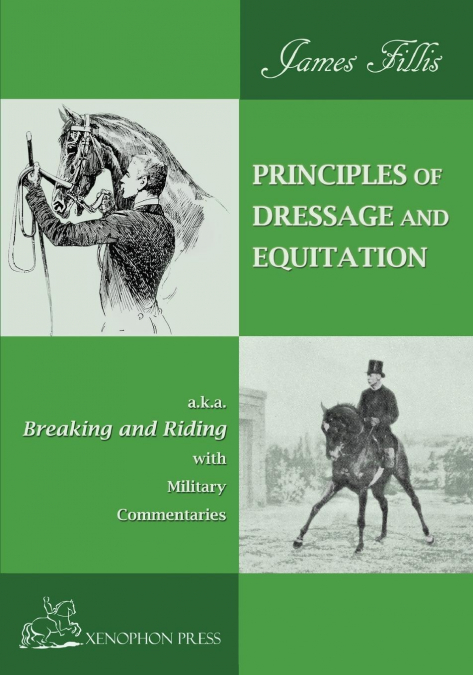

James Fillis', masterwork,áBreaking and Ridingáhas been a touchstone of commonsense training for over a century. Xenophon Press has returned to the original French language manuscript entitledáPrincipe de dressage et d',equitationáand re-translated some of M.H.Hayes', translation of thisáwork',s references to ',breaking.',áFillis', used the term dressage two ways:1. basic training and taming of the horse,2. sophisticated advanced training.At the turn of the century (19-20th), dressageáwas not in use in the English language. Hence, the termáwas omitted from M.H.Hayes first English languageáedition and ',breaking', substituted. Xenophon Press',áedition of this classic is fully footnoted and closely follows the original French edition. Complete military commentaries and robust footnotes make this the authoritative edition.We are proud to finally offer this great work in an appropriately accurate and complete edition.James Fillisá(1834&ndash,1913) was English-born and became a revered French riding master. He was taughtáby Francois Caron, a direct student of Francois Baucher,áand thenástudied with Victor Franconi, owner, and director of the Cirque Olympique de Franconi. Fillis was hiredáto train horses for the French Army during the Franco-Prussian War, and therefore his name is inscribed at Samur on the roll of Ecuyeres Célèbres.Whileáperforming with the Ciniselli Circus in St. Petersburg, Russia - he drewáthe attention of Grand Duke Nicholas, and becameáEcuyer en chefáat the Russian Cavalry School.In this book, I do not presume to discuss scientific subjects. I am simply a horseman who has been among horses for sixty years, who knows them, loves them, and is capable of reasoning about them.The fundamental principle of the studies which I submit to the public is that it is necessary for a horse to be correctly balanced and light in forward movements and propulsion, in order that the rider may obtain the most powerful effects with the least exertion. My method of equitation consists in the distribution of weight by the height of the neck bent at the poll and not at the withers, propulsion by means of the hocks being brought under the body, and lightness by the loosening of the lower jaw. When we know this, we know everything, and we know nothing. We know everything because these principles are of universal application, we know nothing because they have to be applied practically. Practice cannot be taught in a book, but I will try to set forth principles. Probably, I would not have had the boldness to do this, had not one of my pupils entreated me to write this book, because he had been greatly struck with the aptness of the explanation which I gave him respecting the details of the training lessons. In judging this work, I trust that my readers will give it the attention it deserves, as the result of sixty years? serious study and hard practical work.I crave the indulgence of the public and the impartiality of my r